

In the world of premium cigars, certain names transcend the mere concept of a brand. Arturo Fuente one of those houses that have become almost legendary, spoken of with the respect reserved for artisans who have weathered the decades without compromising their integrity. Lighting a Fuente is not just about savoring a cigar; it is about stepping into a family legacy where patience, high standards, and the passing down of tradition matter just as much as the tobacco itself.
The World of Arturo Fuente the Importance of Craftsmanship
Many aficionados are familiar with the elegant band and iconic lines such as Hemingway, Don Carlos, or Opus X, but few truly appreciate the immense amount of work that goes into each vitola. Yet understanding how Arturo Fuente cigars are made profoundly Arturo Fuente the experience. You view the silky wrapper differently, appreciate the smooth draw in a new light, and notice the compact ash, the even burn, and the aromas that unfold in successive waves.
At Fuente, nothing is left to chance. The manufacturing process begins long before rolling. It starts in the fields, with the selection of seeds and the careful cultivation of the plants, and continues through the lengthy phases of fermentation, aging, blending, and quality control. Every leaf destined for the filler, binder, or wrapper follows a precise path. Each liga is conceived as a musical score in which no single note should unnecessarily dominate the others.
What makes the company so unique is also this dual identity. The family’s roots run deep in Cuban tradition, but its modern success has flourished in the Dominican Republic, where Fuente has elevated the art of cigar-making to an exceptional level. There, the climate, the soil, and local expertise have helped build a brand recognized around the world.
So, how is an Arturo Fuente cigar actually made Arturo Fuente From the raw leaf to the moment the flame touches the cigar’s head, the process is long, meticulous, and fascinating. Let’s take a seat in the lounge, trim the head neatly, and trace the steps of this exceptional craftsmanship.
From family roots to the emergence of a unique style
The storyArturo Fuente like many great cigar sagas: with exile, hard work, and an unwavering commitment to tradition. Arturo Fuente, the family patriarch, immigrated from Cuba to the United States in the early20th century, bringing with him a precious legacy: the art of tobacco cultivation and cigar rolling. In 1912, he founded the company in Tampa, Florida, then the American capital of handcrafted cigars. At that time, thousands of torcedores were still working by hand in the factories. The air there was thick, heavy with the scent of fermenting leaves and stories read aloud to keep the workers company.
Arturo Fuente his company in the American capital of artisanal cigars, armed with nothing but Cuban expertise passed down through generations.
But the road was never easy. The Fuente family has weathered fires, economic hardships, tobacco shortages, and periods of near-collapse. Many would have given up. The family, however, always chose to rebuild. It is precisely this series of trials that has forged the brand’s identity. At Fuente, quality isn’t a marketing gimmick; it has become an existential necessity. When you’ve lost everything multiple times, you realize there’s only one thing left to defend: excellence.
In Tampa’s cigar factories, a reader was paid to read novels and newspapers aloud to the cigar rollers all day long—a tradition that originated in Cuba to accompany the repetitive motion of rolling cigars and to keep the workers’ minds engaged.
The true turning point came with Carlos Fuente Sr., and especially Carlos Fuente Jr., key figures in the Dominican renaissance. By shifting a large portion of production to the Dominican Republic, the family found an ideal terroir and a highly skilled workforce. This change did not mean abandoning their Cuban roots—quite the contrary. It was a continuation. The Cuban style—balance, elegance, and meticulous construction—was transplanted to a new land.
This is how what enthusiasts call the Fuente style gradually emerged. A cigar that is often more refined than bold, more complex than flashy, capable of delivering richness without heaviness. Even the stronger sizes adhere to this guiding principle: strength is only valuable if it remains controlled.
This philosophy explains why so many cigar enthusiasts keep coming back to Fuente year after year. There is a reassuring sense of consistency to it. Behind every cigar, you can sense a company that has endured, learned, persevered… and turned setbacks into a legacy.

The terroir and tobacco cultivation: where it all begins
A great cigar is rarely born in a factory. It is born in the soil. At Arturo Fuente, this truth is not a romantic cliché, but a deep conviction. Before it becomes a glossy wrapper or a skillfully assembled filler, a cigar is first and foremost a fragile plant subject to the sun, humidity, wind, and the whims of the seasons.
The Fuente family owns and operates major plantations in the Dominican Republic, particularly in the Château de la Fuente region, which has become almost legendary among connoisseurs. It is there that some of the company’s most sought-after tobaccos have been cultivated, including those used in the famous Opus X line. Few estates have contributed as much to redefining the prestige of Dominican tobacco.

The terroir plays a central role here. The rich, well-drained soils, combined with a tropical climate tempered by altitude and fluctuations in humidity, allow the tobacco to ripen slowly. This slow pace is crucial. Too rapid growth often results in large leaves that lack nuance. Gradual ripening, on the other hand, concentrates the essential oils and refines the aromatic profile.
It all starts with seed selection. Seed lines are chosen based on their resistance, the future texture of the leaves, expected burn characteristics, and the desired flavor profile. Next comes the nursery, where the young plants are carefully monitored before being transplanted into the field.
Tobacco is harvested in successive tiers, working from the bottom to the top of the plant. The lower leaves are wider and milder; the upper leaves, which are more concentrated and robust, are used for the wrapper or binder—each tier has its specific purpose.
The harvest is not completed all at once. Tobacco is picked in successive stages, working from the bottom to the top of the plant. The lower leaves, which are wider and milder, are not used for the same purposes as the upper leaves, which are more concentrated, thicker, and often stronger. This natural hierarchy directly influences their future use as filler, binder, or wrapper.
Fuente also uses different wrapper origins depending on the line: Connecticut for certain creamier blends, Maduro for darker, richer profiles, or Cameroon, renowned for its spicy finesse. Each wrapper alters the perception of the cigar, much like a final coat of varnish changes the depth of fine wood.
At its core, tobacco farming at Fuente is much like serious winemaking: you don’t control nature; you work in harmony with it.
Fermentation, aging, and the creation of ligas
Once harvested, the leaves are still nothing more than a promise. Green, vegetal, and sometimes harsh, they are far from possessing the smooth aromas one expects from a fine cigar. This is where one of the most mysterious and decisive phases begins: fermentation.
The leaves are first sorted by size, texture, color, and position on the plant. They are then stacked into controlled piles called “pilones.” Under the natural effect of residual moisture and pressure, the internal temperature rises. This process transforms the leaf deeply: ammonia levels decrease, sugars evolve, green notes fade, and the structure softens.
During fermentation, the leaves, stacked in piles, naturally heat up due to pressure and residual moisture. The piles are regularly dismantled and rebuilt to ensure a consistent process—too much heat burns the leaves, while too little leaves them underdeveloped.
At Fuente, this stage requires constant monitoring. Too much heat and the leaf deteriorates. Too little, and it remains underdeveloped. The piles are regularly dismantled and rebuilt to ensure consistency throughout the process. It is physical, technical, and almost sensory work. The fermentation masters assess the leaf with their hands as much as with their instruments.
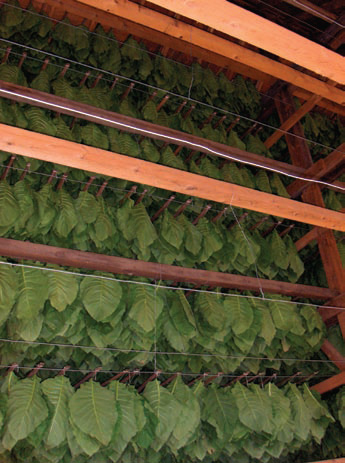
Next comes aging, which can sometimes take several years depending on the tobacco and the blend. During this resting period, the flavors blend together. The rough edges are smoothed out. A bold tobacco becomes more harmonious. This could be compared to the aging of a fine spirit: time doesn’t create everything, but it reveals a great deal.
Then comes the stage that many consider the pinnacle of the art of cigar-making: the creation of the ligas, or blends. A Fuente liga combines different filler leaves—sometimes from multiple regions or harvests—with a structuring binder and a wrapper chosen to complete the blend. The goal is not to simply stack up strength. It is about crafting an aromatic journey.
The Hemingway line often emphasizes elegance and smoothness. Don Carlos offers greater depth, refined spices, and mature complexity. Opus X, on the other hand, is more intense, with an opulent richness that remains well-balanced.
Creating a well-balanced blend requires an immense sensory memory. One must envision how the leaves will develop together after rolling, resting, transport, storage, and finally combustion. Few professions demand such foresight.
When we talk about the Fuente taste, we’re talking less about a fixed recipe and more about a constant art of balance.
Hand-rolling and quality control
Even with the finest tobaccos in the world, a poorly rolled cigar is still a disappointment. The torcedor’s skill therefore remains essential. At Fuente’s factories, hand-rolling holds a sacred place. It’s not just a show for visitors. It’s the very foundation of consistency.
The roller begins by selecting the leaves intended for the filler, the aromatic heart of the cigar. They are arranged according to a precise method to ensure a smooth draw and even burn. If packed too tightly, they would stifle the smoke. If packed too loosely, they would burn quickly and hot. That is the challenge: achieving the right density without restricting the cigar’s airflow.
Wrapped around the filler is the binder, which holds the structure together. Then the wrapper, the visible outer leaf, is carefully applied. It is the wrapper that the hand caresses, the part that catches the eye before lighting up the cigar. At Fuente, the wrapper must be taut, smooth, and free of unsightly veins, with an almost satiny texture depending on the series.
Some vitolas require superior craftsmanship. The figurados and perfectos, hallmarks of the Hemingway line, demand that the ends be crafted with remarkable precision. These cigars are more difficult to produce and take longer to roll, but they are often magnificent both in the hand and on the palate.
The Figurados and Perfectos in the Hemingway line are among the most difficult vitolas to roll: their pointed ends require a level of precision that only the most experienced torcedores can master, making them both rare and particularly prized by connoisseurs.
Once rolled, the cigars undergo several inspections. Their weight, firmness, appearance, and sometimes draw are checked using specialized tools. Consistency is a quiet obsession. The smoker should experience the same performance from one cigar to the next.

Next come the application of the bands, packaging, and, most importantly, a final resting period. This final rest allows the leaves, which have been slightly stressed by the rolling process, to rebalance themselves. Many people underestimate this phase. Yet a freshly rolled cigar has not yet fully expressed its character.
When you light an Arturo Fuente the smoke flows naturally, cool, and abundant, with a clean burn, remember one thing: this apparent ease is the result of countless unseen efforts.
Why the Arturo Fuente flavor Arturo Fuente instantly recognizable
There are cigars that are technically perfect but lack character. And there are brands capable of creating a distinctive flavor profile that’s recognizable almost instantly. Arturo Fuente clearly Arturo Fuente to the latter category.
The first striking feature is often its balance. Even in full-bodied blends, the intensity doesn’t overwhelm the palate. The flavors unfold in layers: fine wood, cedar, roasted coffee, cocoa, mild spices, and sometimes dried fruit or floral notes, depending on the blend. Nothing seems forced. Everything is carefully crafted.
Next comes the smoke texture. Many enthusiasts note that Fuente cigars produce a dense yet silky smoke—enveloping without being heavy. This is due as much to the quality of the fermentation process as to the precision of the rolling. A harsh smoke often reveals flaws, while a velvety smoke speaks to a masterful craftsmanship.
The compact, light ash of an Arturo Fuente often cited as an indicator of quality: it reflects the evenness of the burn and the precision of the roll. A well-constructed cigar burns straight, requiring no adjustments, allowing the smoker to focus on the taste.
The burn also plays a role. A good Fuente burns evenly. The ash forms a firm, often light-colored and compact layer. The cigar requires little attention, allowing the smoker to focus on what matters most: the taste, the conversation, and the moment.
But beyond the technical aspects, the Fuente signature stems from a sense of emotional coherence. Each collection has its own personality, yet they all share the same vision of understated luxury: never overdoing it. While some brands seek immediate impact, Fuente often prefers a gradual build-up, subtlety, and the reward that comes from taking the time to appreciate it.
Perhaps that’s why so many enthusiasts save a Fuente for special occasions. A birth, a milestone, a reunion, a quiet evening after a long inner struggle… These cigars are the perfect companion for moments that deserve more than just a quick smoke.
Recognizing an Arturo Fuente is not just about identifying a particular taste. It is about recognizing a way of approaching pleasure: serious, generous, patient, and deeply human.
Conclusion – More than just a cigar, a living legacy
Understanding how Arturo Fuente cigars are made reveals that no detail is left to chance. From the carefully selected seed to the final rolling, through fermentation, aging, and the creation of the ligas, every step is driven by a single goal: to deliver a consistent and memorable experience.
Fuente has not built its reputation on fanfare, but on the quiet pursuit of excellence. It has weathered trials, moved to new lands without losing its soul, and transformed the cigar into both a cultural artifact and a sensory pleasure.
The next time you light up an Arturo Fuente, take a few seconds before your first puff. Look at the wrapper, smell the dry aromas, and examine the construction. Behind this simple moment lie years of hard work, patience, and family passion.
A fine cigar always tells a story. At Fuente, that story continues to this day.
FAQ
Arturo Fuente all of its cigars in the Dominican Republic?
The vast majority of modern premium lines are manufactured in the Dominican Republic, the brand’s main production hub. Historically, the brand was founded in Tampa, Florida, but its international growth has been built around its Dominican manufacturing facilities.
Why are OpusX cigars so sought after?
OpusX cigars have made history by proving that a Dominican wrapper can rival the most prestigious origins. Their limited production, rich aroma, and iconic status make them highly sought-after cigars.
How long do Fuente cigars age?
This varies depending on the tobacco and the brand. Some leaves are aged for several years before rolling. After that, the rolled cigars are often allowed to rest further before being sold.
Arturo Fuente cigars strong?
Not necessarily. The range is quite broad. Some models are mild to medium-bodied and very accessible, while others—such as certain OpusX versions—offer more body and intensity. The brand is best known for its balance rather than its raw strength.
Which cigar size should you choose to try the brand?
For a first try, many enthusiasts recommend a Hemingway Short Story, a Don Carlos Robusto, or a classic cigar of moderate strength. These formats showcase the brand’s finesse without overwhelming the palate.

